
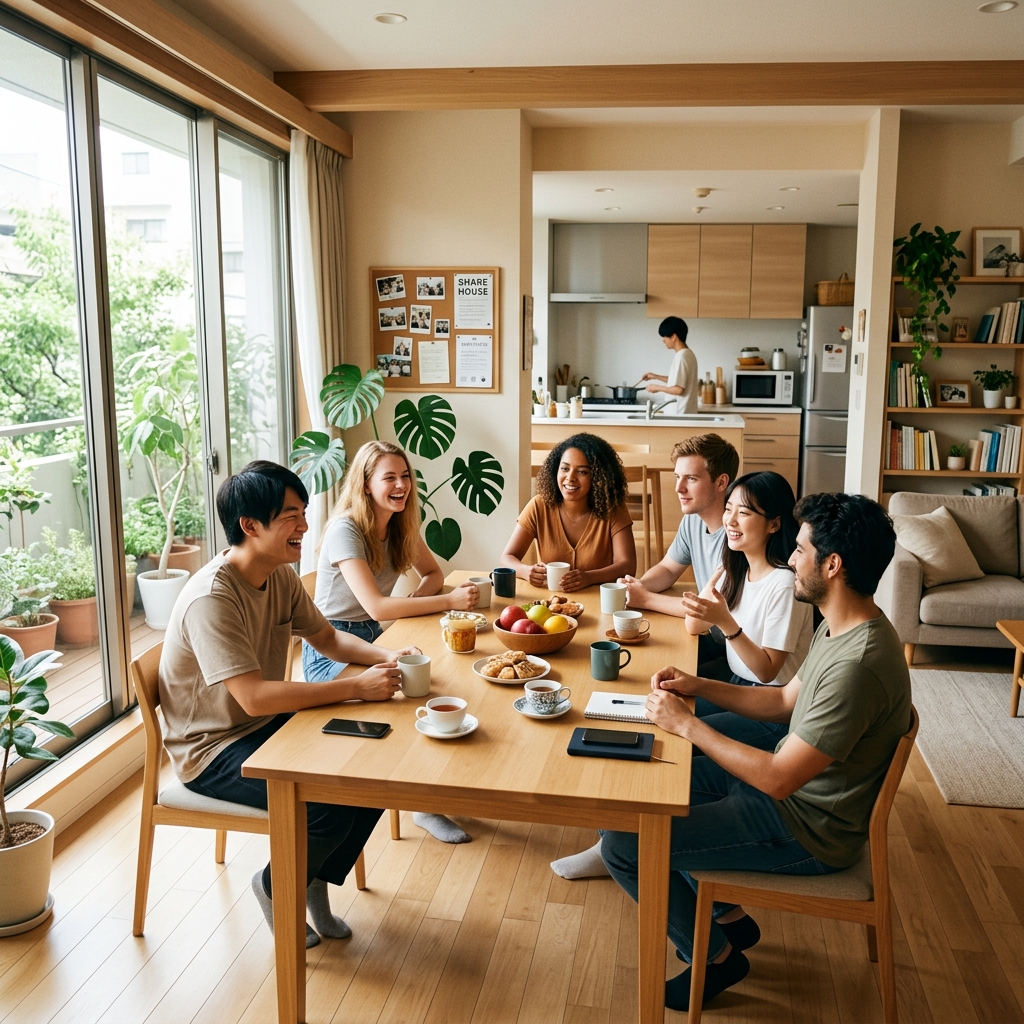
Finding a place to live is one of the most critical steps when moving to Japan as an international student or expat. The two main housing options are renting a private apartment or moving into a share house. Each option represents a completely different lifestyle and budget requirement. In this guide, we will break down the differences in costs, paperwork, social life, and rules to help you choose the perfect home.
Quick Comparison: Share House vs. Private Apartment
Here is a quick look at how these two housing types stack up against each other:
| Feature | Share House (e.g., Oakhouse) | Private Apartment |
|---|---|---|
| Initial Cost | Low (usually 30,000 to 50,000 JPY deposit) | High (3 to 5 months of rent upfront) |
| Guarantor Needed? | No (usually just an emergency contact) | Yes (guarantor company or Japanese national) |
| Furniture & Utilities | Fully furnished, flat-rate utilities included | Unfurnished, utilities paid separately |
| Social Aspect | High (shared kitchens, lounges, events) | Low (complete privacy and independence) |
| Contract Length | Flexible (monthly or short-term) | Rigid (typically a 2-year lease agreement) |
1. Share Houses: Hassle-Free and Social
A share house is a residential option where you have a private bedroom (or shared dorm room), but share common areas like the kitchen, living room, bathrooms, and laundry facilities with other residents. Popular providers include Oakhouse and Borderless House, which cater specifically to international residents.
- No Guarantor Obstacles: Unlike traditional renting, share houses do not require a Japanese guarantor (guarantor person) or expensive guarantor insurance.
- Built-in Community: Share houses are ideal for making friends and practicing Japanese. Providers like Borderless House maintain a 50/50 ratio of Japanese nationals to international residents.
- Roommate Rules: Living with others means following rules. Most share houses have guidelines regarding kitchen cleanup, quiet hours (usually after 10:00 PM), and rubbish separation.
2. Private Apartments: Independence and Privacy
If you prefer having your own kitchen, bathroom, and washing machine, renting a private apartment is the way to go. However, the process for foreign students can be complex and expensive due to traditional Japanese real estate customs.
- High Initial Fees: You must pay key money (Reikin - a non-refundable gift to the landlord), security deposit (Shikikin), real estate agent commission, and first month's rent. This can easily total 200,000 to 350,000 JPY.
- The Guarantor System: Landlords require a Japanese guarantor or a guarantor company (Hoshonin-gaisha) to co-sign the lease. For official renting regulations, refer to the Ministry of Land, Infrastructure, Transport and Tourism (MLIT) guides.
- Unfurnished Spaces: Most apartments in Japan come completely empty—meaning you will need to purchase your own refrigerator, washing machine, curtains, and light fixtures.
3. Roommate Rules and Daily Etiquette
Whether in a share house or a private apartment, local custom is paramount. In a share house, you will share chore rotations for cleaning common areas. In a private apartment, you are solely responsible for noise control (Japanese walls are notoriously thin) and sorting your trash into burnable, non-burnable, and recyclable materials, which is strictly enforced by municipal ward offices.
Warning: Violating trash disposal rules or playing loud music at night can lead to formal complaints from neighbors and potential eviction warnings from your management company.
4. Plan Your Housing Budget and Location
Before signing any lease, it is vital to calculate your monthly expenses. Utilities in private apartments fluctuate, while share houses charge a flat utility fee. Use the yuzu.help Student Budget Calculator to compare housing costs side-by-side. Additionally, check out the yuzu.help Interactive Map to explore commuter train routes and find affordable residential areas near your campus.
Frequently Asked Questions
Q: What is key money (Reikin) in Japanese apartment rentals?
Key money (Reikin) is a traditional, non-refundable gratuity fee paid to the landlord. It is typically equivalent to one or two months of rent.
Q: Do I need a Japanese guarantor to rent a share house?
No. Most share house companies like Oakhouse and Borderless House do not require a Japanese guarantor; you only need to provide an emergency contact.
Q: Are utilities included in share house rent?
Yes. Share houses usually charge a flat monthly maintenance fee (typically 10,000 to 15,000 JPY) that covers electricity, gas, water, and high-speed internet.
Q: Can I have friends or family stay overnight in a share house?
It depends on the house rules. Many share houses strictly prohibit overnight guests in private rooms for safety and privacy reasons, while others allow it with prior notice and a fee.
Q: How long is a standard private apartment contract in Japan?
A standard residential lease contract for a private apartment in Japan is two years. Leaving early may result in a one-month rent penalty.
Q: What happens if I do not have a Japanese guarantor for an apartment?
If you lack a Japanese guarantor, you must use a guarantor company (Hoshonin-gaisha) approved by the landlord, which charges an upfront fee of 50% to 100% of one month's rent.
Q: Is it easy to find a fully furnished private apartment?
Fully furnished private apartments exist (such as LeoPalace21) but they are less common and usually command a higher monthly rent compared to unfurnished units.
Q: Can two students share a private studio apartment to save money?
Most single-occupancy studio apartments (1K or 1DK) in Japan have strict rules against multi-person occupancy. You must look specifically for "room-sharing allowed" (room-share ka) properties.