
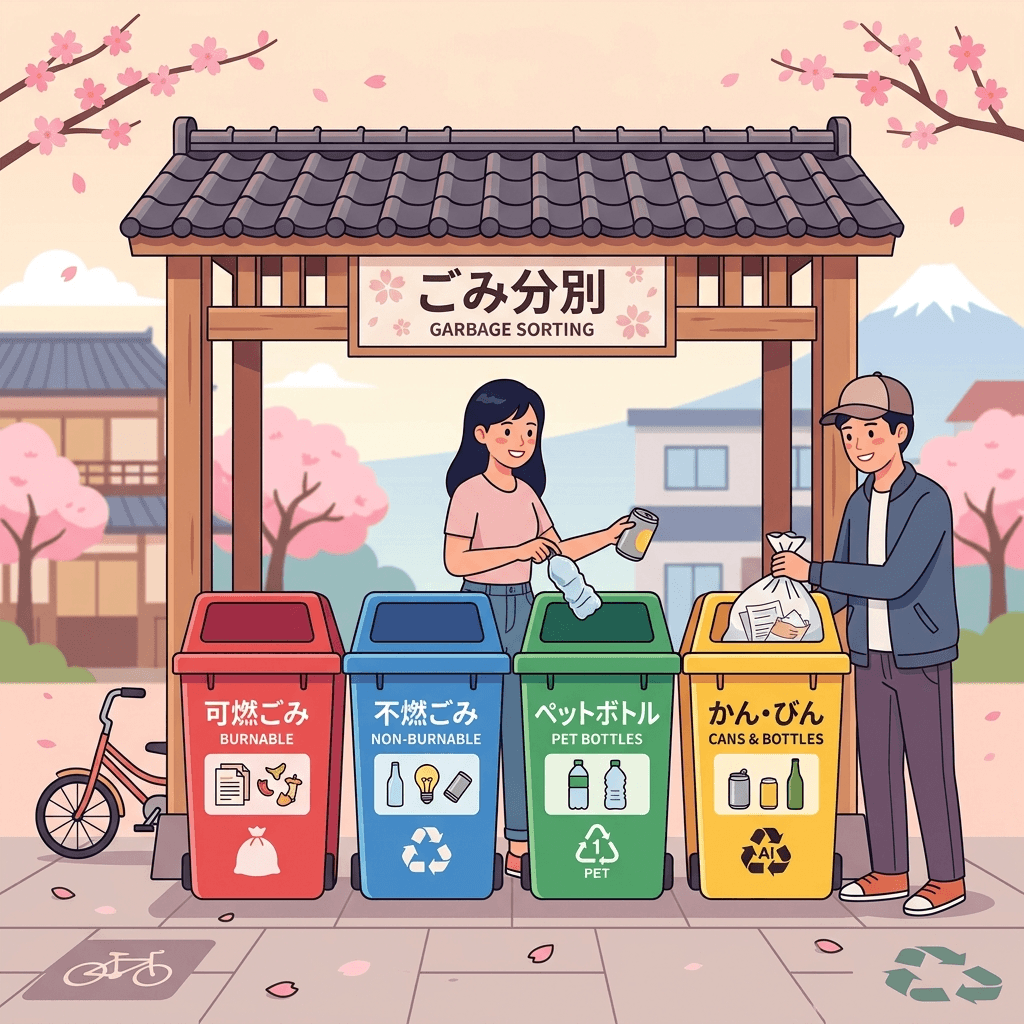
One of the first and most surprising culture shocks international students and expats experience when moving to Japan is the country's meticulous trash disposal system. Unlike many countries where all garbage goes into one or two bins, Japan requires you to sort your waste into multiple precise categories, place them in designated bags, and throw them out only on specific days and times. While it may seem overwhelming at first, mastering the garbage rules is essential to keep peace with your neighbors and avoid municipal warnings. This comprehensive guide will show you how to classify your trash, read collection schedules, and handle large household items.
1. The Four Main Garbage Categories
While exact categories vary slightly by city and ward (ku), most municipalities in Japan divide residential waste into four main groups:
- Combustible/Burnable Waste (可燃ごみ - Kanen Gomi): Includes food scraps, paper waste, tissues, rubber, leather, and small wooden items. Food waste must be thoroughly drained of water before throwing it away.
- Incombustible/Non-Burnable Waste (不燃ごみ - Funen Gomi): Includes glass items, light bulbs, ceramics, metal kitchen utensils, and small electrical appliances.
- Recyclable Resources (資源ごみ - Shigen Gomi): Divided into subgroups:
- PET Bottles: Caps and labels must be removed (discarded as plastic/burnable), and the bottle rinsed.
- Cans & Glass Bottles: Rinsed and sorted separately.
- Paper & Cardboard: Tied neatly with paper string.
- Plastic Packaging (プラスチック - Purasuchikku): Trays, food wrappers, and plastic containers. In some wards, clean plastic packaging is collected separately from burnable trash.
2. Understanding Rules, Bags, and Collection Schedules
Every apartment building has a designated trash collection spot (ごみ置き場 - Gomi Okiba). You must follow these strict rules to ensure your trash is collected:
- Use Designated Garbage Bags: Many cities (like Kyoto or Sapporo) require residents to purchase official, color-coded municipal garbage bags at local supermarkets or convenience stores. Wards in central Tokyo (like Shinjuku or Shibuya) allow standard semi-transparent bags. Black or opaque bags are strictly prohibited.
- Throw Out Trash on the Right Day: You will receive a color-coded Garbage Collection Calendar (ごみ収集日カレンダー) from your ward office when you register your address. Combustible trash is usually collected twice a week, recyclables once a week, and non-combustibles once or twice a month.
- Observe Collection Times: Trash must be taken out either the night before or early in the morning (usually before 8:00 AM) on the collection day. Leaving trash out at incorrect times invites crows and stray cats, causing neighborhood friction.
3. Disposing of Oversized Trash (Sodai Gomi)
Large household items—such as furniture, bicycles, mattresses, or luggage—cannot be thrown out with regular garbage. Throwing these items out on the street constitutes illegal dumping (不法投棄 - Fuhou Touki), which carries heavy fines. Instead, you must follow the Sodai Gomi (粗大ごみ) procedure:
- Apply Online or by Phone: Visit your local municipality's Sodai Gomi website and book a collection date.
- Buy Collection Stickers: Purchase Sodai Gomi Stickers (粗大ごみ処理券) at a local convenience store. Wards use stickers labeled "A" (usually 200 JPY) and "B" (usually 300 JPY). The reservation office will tell you exactly how many stickers your item requires.
- Attach and Place Outside: Write your name or reservation number on the stickers, attach them to the items, and place the items at the designated collection spot by 8:00 AM on your scheduled date.
4. Home Appliance Recycling Law
Under Japanese law, four specific major appliances cannot be collected as Sodai Gomi: Televisions, Refrigerators/Freezers, Washing Machines/Dryers, and Air Conditioners. To dispose of these, you must contact the retail store where you bought them (or a local electronics shop) and pay a recycling fee plus transportation costs, or use a certified private recycling service.
Conclusion
Getting used to Japan's garbage rules takes some practice, but it quickly becomes second nature. Keep your ward's garbage calendar posted on your refrigerator, wash out your recyclables, and remember to buy official trash bags if required by your city. Being mindful of your trash disposal shows respect for your local community and ensures a smooth expat life in Japan!