
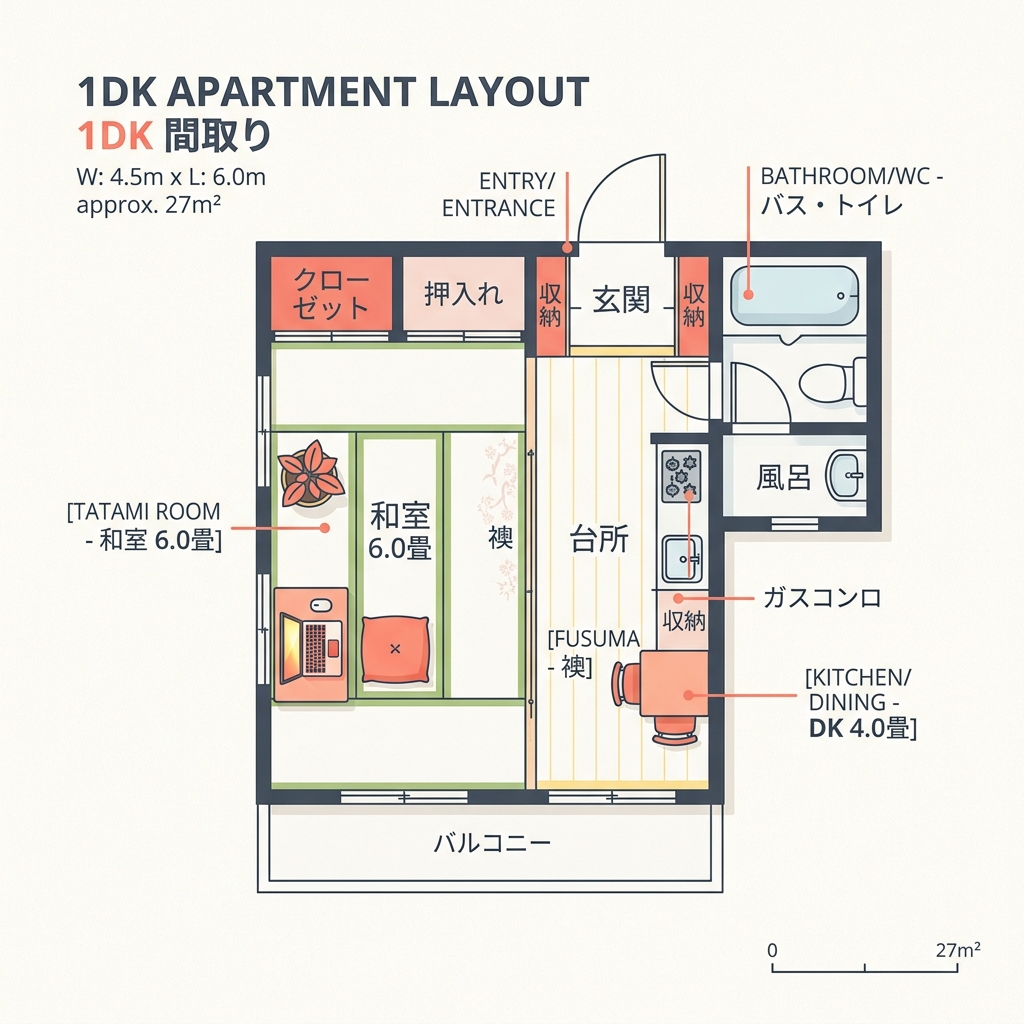
Apartment hunting in Japan is an exciting milestone, but scanning Japanese real estate websites (like Suumo or Homes) can feel like trying to decipher secret codes. Listings are filled with terms like "1R," "1LDK," or "Apato" and "Mansion." To help you navigate the renting market, this guide breaks down the exact differences between Japanese apartment layouts and building structures, ensuring you find a space that fits both your lifestyle and budget.
Decoding the Layout Codes: 1R, 1K, 1DK, and 1LDK
In Japanese real estate terminology, the number indicates the number of separate bedrooms/living rooms, while the letters represent the functional spaces. Here is what they stand for:
- Number (e.g., 1, 2, 3): The number of actual rooms in the apartment (excluding bathrooms and kitchens).
- R (Room): A single open room.
- K (Kitchen): A kitchen area.
- D (Dining): A dining area.
- L (Living): A living room space.
Let's look at the most common single-resident layouts:
| Layout | Meaning | Average Size | Best For |
|---|---|---|---|
| 1R (1 Room) | A single room where the kitchen stove, sink, and fridge are located in the main living space. There is no wall or door separating the cooking area from where you sleep. | 12 – 18 m² | Students on a tight budget who don't cook heavily. |
| 1K (1 Kitchen) | Similar to a 1R, but the kitchen is separated from the main living/sleeping room by a wall and a door. This keeps cooking odors and noise out of your bedroom. | 18 – 23 m² | Single expats who want privacy and cook occasionally. |
| 1DK (1 Dining Kitchen) | A one-bedroom apartment where the kitchen space is large enough to fit a small dining table and chairs. The kitchen/dining area is separated from the bedroom. | 25 – 35 m² | Expats who want a clear boundary between cooking, eating, and sleeping. |
| 1LDK (1 Living Dining Kitchen) | A spacious layout featuring one private bedroom and a large, separate open-plan living, dining, and kitchen area. | 35 – 50 m² | Couples, professionals, or anyone desiring ample living space. |
Apato vs. Mansion: What is the Difference?
In English, the word "mansion" conjures images of a sprawling luxury estate. In Japan, however, Mansion (マンション) and Apato (アパート) simply refer to two distinct types of apartment building structures. Understanding this difference is crucial for your comfort and safety:
1. Apato (アパート)
Apato are wood-frame or light-gauge steel buildings, typically only two stories tall.
Pros: Rent is significantly cheaper, and upfront fees (like key money or agency commissions) are often lower or negotiable.
Cons: Sound insulation is thin; you will likely hear your neighbors walking or talking. Thermal insulation is also weaker, meaning apartments get very cold in winter and hot in summer. They lack modern security gates, elevators, or delivery lockers (takuhai box).
2. Mansion (マンション)
Mansions are taller residential complexes constructed from reinforced concrete (RC) or steel-reinforced concrete (SRC).
Pros: Exceptional soundproofing and thick walls. Reinforced concrete offers excellent insulation, retaining heat in the winter and air conditioning in the summer. They are highly earthquake-resistant and feature advanced security (auto-locking lobby doors, security cameras, and intercoms).
Cons: Rent is much higher, and monthly management/maintenance fees (kanri-hi) are standard.
Other Key Real Estate Terms to Know
While browsing listings, you may also encounter these common terms:
- S (Service Room / Storage): An extra room that is too small or lacks the required window surface area to be legally classified as a bedroom. You will see listings like 1LDK+S.
- Loft (ロフト): A raised platform or mezzanine level accessed by a ladder, common in 1R and 1K apartments. It is typically used for sleeping or storage to maximize floor space.
- Washitsu (和室): A traditional Japanese room featuring tatami mat flooring, sliding paper screens (shoji), and closets with sliding doors (fusuma).
- Unit Bath (UB): A pre-fabricated plastic bathroom pod where the toilet, sink, and bathtub are all in the same room. A separate toilet and bath is called Bus-Toilet Betsu.
Summary: Which One Should You Choose?
For international students or young professionals arriving in Japan, a 1K Apato strikes the best balance of affordability, privacy, and space. If you are sensitive to noise or want premium security features, upgrading to a 1K or 1DK Mansion is highly recommended. Whichever path you choose, make sure to read the layout blueprints carefully before signing your lease!