
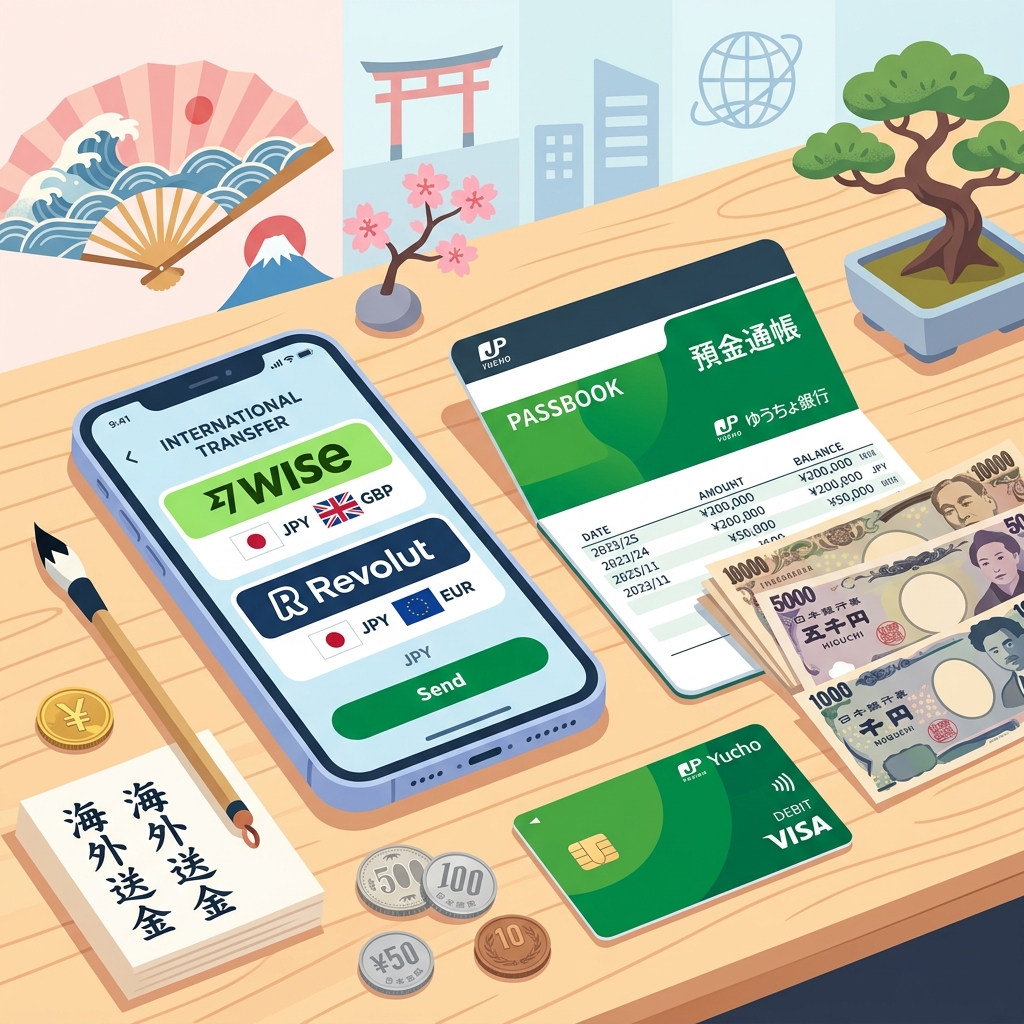
Moving to Japan is an exciting adventure, but navigating the country's unique financial ecosystem can quickly become overwhelming. For international students, language school attendees, and foreign professionals, understanding how to manage money, open a bank account, and transfer funds internationally without losing a small fortune to exchange rates and hidden fees is crucial. Traditional Japanese banks are notorious for their complex procedures, strict rules for foreigners, and high transaction costs. This ultimate guide will demystify Japan's banking landscape, compare the best money transfer services like Wise and Revolut, walk you through opening a Japan Post Bank (Yucho Ginko) account, and outline the cheapest ways to handle large payments like university tuition fees.
The Expat Financial Challenge in Japan
Japan remains a cash-dominant society in many aspects, despite a rapid post-pandemic push toward digital payments. Upon arrival, you will find that cash is required for ward office registrations, initial rent payments, commuting cards, and daily food expenses. However, carrying large amounts of cash from your home country is risky and often results in terrible exchange rates at airport currency booths. Meanwhile, traditional bank wire transfers (such as SWIFT) involve intermediate bank charges, receiving fees, and uncompetitive exchange rates that eat away at your savings. To optimize your finances, you need a strategy that combines digital-first international accounts with local Japanese banking. Let's break down how to achieve this.
Part 1: How to Open a Japan Post Bank (Yucho) Account
For newly arrived expats (especially those who have been in Japan for less than six months), opening a bank account at traditional commercial institutions like MUFG, SMBC, or Mizuho is nearly impossible. Under Japanese foreign exchange and trade laws, foreign residents are classified as "non-residents" for their first six months, making them ineligible for standard accounts. Fortunately, Japan Post Bank (Yucho Ginko / ゆうちょ銀行) is a major exception and is the default choice for students and new expats.
Why Choose Yucho Ginko?
- No 6-Month Rule: Yucho allows foreign residents to open a basic cash card account immediately upon arrival, provided they have a valid visa and address.
- Accessibility: Yucho has the largest network of branches and ATMs in Japan, available in almost every post office, convenience store, and train station.
- Low Fees: ATM withdrawals are free during standard operating hours at Yucho ATMs.
Document Checklist for Yucho
| Required Document | Important Specifications | Purpose |
|---|---|---|
| Residence Card (Zairyu Card) | Must have your current Japanese address printed on the back (after registering at the local ward office). | Primary identification and proof of address. |
| Passport | Must contain a valid visa sticker (Student, Work, etc.) with an entry stamp. | Proof of legal entry and identity. |
| Student ID / Certificate of Enrollment | Required if you are opening a student-designated account. | Verifies your school affiliation and student status. |
| Hankou (Personal Seal) | Optional but recommended. Most Yucho branches now accept signatures (shomei), but a cheap hanko is helpful. | Official authorization signature. |
| Japanese Phone Number | A valid active mobile number is required to complete the application. | Security verification and contact. |
Step-by-Step Application Process
- Register Your Address First: You cannot open a bank account without your address registered on the back of your Residence Card. Visit your local ward office (kuyakusho) first.
- Find Your Closest Branch: Go to the post office closest to your home or school. Branches outside your residential area may reject your application due to anti-money laundering regulations.
- Request a General Account: State to the counter staff: "Kouza wo tsukuritai desu" (I would like to open an account). You will be given a form to fill out.
- Choose Your PIN: You will select a 4-digit PIN for your cash card. Do not use easy combinations like your birthday.
- Receive Your Passbook: You will get your paper passbook (tsucho) immediately. Your actual cash card will be mailed to your registered address in 1 to 2 weeks.
Tip: To avoid foreign transaction limitations on your Yucho account during the first 6 months, verify with your school or employer if they require a specific account configuration for tuition deposits or salary payments.
Part 2: Wise vs. Revolut for Expats in Japan
Once you have a local Japanese bank account, you need a way to transfer money from your home country into Yen. Traditional international bank transfers cost around 3,000 to 5,000 JPY per transaction, plus a hidden markup of 2-5% on the exchange rate. Utilizing international financial apps like Wise (formerly TransferWise) and Revolut is the ultimate hack to save money.
1. Wise (The Best for Multi-Currency Transfers)
Wise is the gold standard for expats moving money into Japan. It uses the real mid-market exchange rate (the one you see on Google) and charges a small, transparent transaction fee (usually between 0.4% and 0.9% depending on the currency pair).
- Local Bank Details: You can hold and exchange Japanese Yen alongside your home currency. Wise provides you with local banking details in the US, UK, EU, Australia, and more, allowing family members to deposit local money easily.
- Direct Transfer to Japanese Accounts: You can send money directly from your Wise account to your Yucho Ginko account. Because Wise operates local bank accounts in Japan, your transfer arrives as a local bank transfer (furikomi), meaning your Japanese bank will not charge you an international receiving fee.
- Delivery Speed: Small transfers (under 1 million JPY) are often processed within minutes, using local instant transfer networks.
2. Revolut (The Best for Card Spending & ATM Access)
Revolut is a digital banking app that offers excellent features for daily card spending and low-fee ATM access in Japan.
- Zero Fee Exchange Limits: Standard Revolut users can exchange up to 1,000 USD (or equivalent) per month into Yen with zero markup fee during weekdays. A small 1% weekend fee applies.
- ATM Cash Withdrawals: With a physical Revolut card, you can withdraw cash from Japanese convenience store ATMs (like 7-Eleven or Lawson). Standard users can withdraw up to 25,000 JPY per month with no Revolut fees (convenience store ATM fee may still apply).
- Instant Card Blocking: The app lets you freeze and unfreeze your card instantly, offering excellent security in case you misplace it while traveling.
Comparison Table: Wise vs. Revolut
| Feature | Wise | Revolut |
|---|---|---|
| Exchange Rate | Real mid-market rate (no markup). | Real mid-market rate (with weekday limits, 1% weekend fee). |
| Transfer Fees | Low percentage-based fee (0.4% - 0.9%). | Free up to monthly limit, then 0.5% - 1.0%. |
| Best For | Sending larger sums directly to Japanese bank accounts. | Daily card transactions and emergency ATM cash withdrawals. |
| Card Fee | One-time fee to order card (approx. $9). | Free standard card (delivery fee may apply). |
Part 3: Managing Large Payments (University & Language School Tuition)
Paying tuition fees is one of the largest financial tasks for international students in Japan. Typically, schools require tuition to be paid in full before your Certificate of Eligibility (COE) is issued or at the start of each semester. These transfers are usually in the range of 500,000 JPY to 1,500,000 JPY.
Why You Should Avoid Traditional Swift Bank Transfers
If you ask your local home bank to wire money to your Japanese school via SWIFT, you will likely face three problems:
- Bad Exchange Rates: Home banks often charge an exchange markup of 3-5%, costing you an extra $300 to $500 on a $10,000 tuition payment.
- Intermediary Bank Fees: Intermediary banks along the route will deduct fees from the payment. If your school receives even 1,000 JPY less than the required tuition, you will have to pay the difference upon arrival.
- Slow Processing: Traditional SWIFT transfers can take 3 to 7 business days to clear, causing unnecessary stress before enrollment deadlines.
How to Use Wise to Pay Tuition Safely
To ensure your school receives the exact amount of tuition with minimal fees, follow these steps:
- Get the Invoice: Obtain the school's bank details (Bank name, branch name, account type, account number, and account name in Katakana).
- Create a Wise Transfer: In your Wise app, select "Send Money" and set the target currency to JPY.
- Select "Recipient Pays Fees" or Set Exact Amount: Input the exact Yen amount requested by your school. Wise will calculate the precise cost in your home currency.
- Input Katakana Account Details: Input the recipient details carefully. Katakana name matches must be exact (e.g., ガッコウホウジン...).
- Fund the Transfer: Transfer the money from your local bank account to Wise. Wise will convert and deliver the exact Yen amount locally to your school.
Part 4: Daily Spending and Cashless Payments in Japan
Once you are settled, you need to transition into daily spending. While Japan is cash-based, cashless options are expanding rapidly, especially in Tokyo, Osaka, and Fukuoka.
1. IC Cards (Suica / Pasmo)
These are rechargeable contactless transit cards. You can load cash onto them and use them to pay for trains, buses, vending machines, convenience stores, and even many casual restaurants. You can add them to Apple Wallet or Google Wallet for easy mobile payment.
2. PayPay
PayPay is the most popular QR-code payment app in Japan. You link it to your Yucho Ginko account or charge it with cash at Seven Bank ATMs. It is accepted at small shops, markets, and restaurants where credit cards are not.
3. Yucho Debit Card
When you open your Yucho account, request a Yucho Debit card (Visa/JCB branded). This card links directly to your bank account balance, allowing you to pay at major retailers and make online purchases without needing a credit card.
Expat Money Checklist
Follow this checklist to establish your financial setup in Japan:
- [ ] Register your address at the local ward office.
- [ ] Open a Japan Post Bank (Yucho Ginko) account at your nearest branch.
- [ ] Set up a Wise account and verify your identity before leaving your home country.
- [ ] Order physical Wise and Revolut cards for travel and emergency ATM access.
- [ ] Load your digital Suica/Pasmo card onto your phone.
- [ ] Link your Yucho account to PayPay for daily QR code payments.